
Europe Packing List: One-Bag Travel Essentials for Any Season



Updated September 16, 2026.
This Europe packing list is the one Peter and I use. Our first trip to Greece was our honeymoon in May 2018, and we did the whole thing with a single carry-on backpack each. We went back for our five-year anniversary in April 2023 and packed exactly the same way. I have been traveling to Europe for more than 30 years and on every warm-weather trip now we pack one bag each. No checked luggage, no waiting at the carousel and no dragging a suitcase over cobblestones.
What you will find here is more than a list of clothes. There are the travel essentials worth packing every time, what goes in your personal item for the flight, eight outfits built from the same handful of pieces and a carry-on size chart for 20 European airlines, checked against each airline’s own baggage page instead of a luggage website. That last part matters more than most Europe packing lists admit, because a bag that flies across the Atlantic without a second look can get stopped at the gate on a short flight within Europe.
Disclaimer: Links may contain affiliate links, which means we may get paid a commission at no additional cost to you if you purchase through this page. Read our full disclosure here.
Table of Contents-Click to Expand
- How I Pack One Bag for Europe
- Europe Travel Essentials Worth Packing Every Time
- The Complete Europe Packing List
- What Goes in Your Personal Item
- European Carry-On Size Chart by Airline
- Eight Outfits From One Bag
- Europe Packing List by Season
- Packing List for Europe: 2 Weeks or Longer
- Backpacking Europe With One Bag
- Documents, Money and Entry Rules
- Packing for Greece and the Islands
- Airport Lounges for Long Travel Days
- Frequently Asked Questions
- How I Keep This Guide Current
How I Pack One Bag for Europe
Europe rewards light packers. Old hotels have narrow staircases and no elevator, trains have limited luggage space and a lot of the best streets are cobblestone. The moment you step off the plane with one bag, you can easily hop on a bus or train, walk to your hotel and move between cities without planning your day around a suitcase.
These are the rules that make one bag work for me:
- One carry-on and one personal item. Nothing checked.
- Wear your heaviest pieces on travel day. My jacket, dressy black jeans and bulkiest shoes go on my body, not in the bag.
- The list does not grow when the trip does. Two weeks means a load of laundry or washing in the sink, not more clothes.
- Three pairs of shoes, maximum, and that includes the pair on your feet.
- Check your airline before you pack. European carry-on limits vary more than most Americans expect, which is in the chart below.
The Bag I Use
My current bag is the Bagsmart Blast Pro 43L roller backpack. It measures 55 x 35 x 23 cm (21.7 x 13.8 x 9.1 inches) and weighs 6.7 pounds empty, with wheels for the airport and backpack straps for stairs and cobblestones. Packed for a real trip, mine weighs 17 pounds. Keep that number in mind when you get to the airline chart, because weight is where a roller backpack costs you.
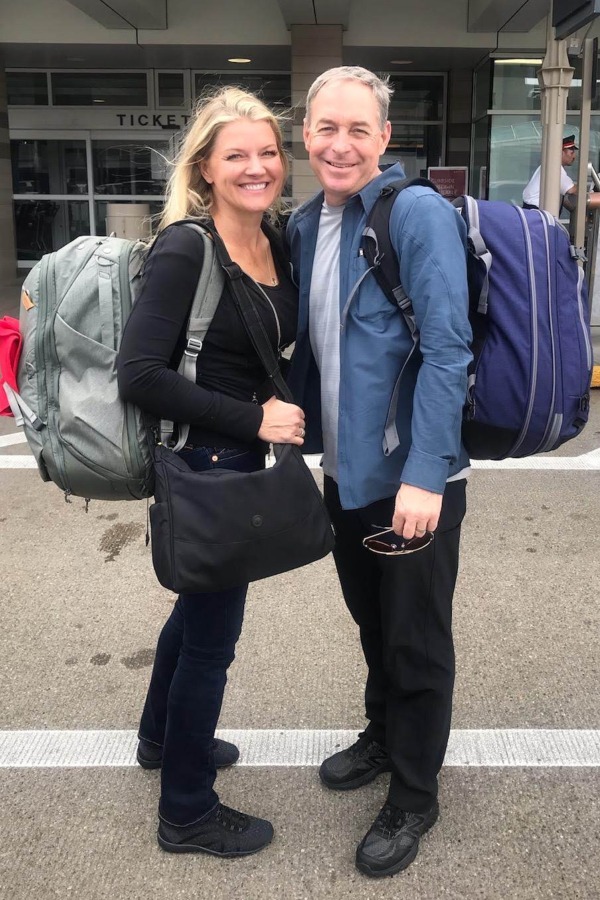
Before the Blast Pro, I carried the Peak Design 45L travel backpack starting with that 2018 honeymoon. It is the bag in the photo above and it held up beautifully, but on long transit days with a laptop inside it could strain my shoulders. If that sounds familiar, a roller backpack gives you both options: roll through the airport, then carry it where wheels are useless.

Whatever bag you choose, check two numbers before you buy: its depth and its empty weight. A bag deeper than about 20 cm (7.9 inches) fails the sizer at several budget airlines and a heavy empty bag eats into the 8 kg (17.6 pound) limit some full-service carriers use.
Europe Travel Essentials Worth Packing Every Time
If you are working out what to pack for Europe and only read one section, make it this one. These are the travel essentials for Europe worth packing on every trip, whatever the season or the trip length.
- A small crossbody purse worn in front. Hands free, zipped and in front of you in crowded places where pickpocketing happens. I use this cross-body travel purse.
- Plug adapters with built-in USB ports. Most of continental Europe uses Type C and Type E/F outlets. Adapters with USB ports mean you carry fewer pieces.
- A travel power strip rated for 250V. Plug one adapter into a travel power strip and charge everything at once. Check the voltage rating on any strip you bring, because many US strips are rated only for 125V.
- A power bank. Always in your personal item. Airlines do not allow spare lithium batteries in checked or gate-checked bags.
- An AirTag or other tracker in each bag. If your carry-on gets tagged at the gate and sent under the plane, you will know where it is.
- Compression socks for the long flight. The research on these is better than you might expect (more below).
- A lightweight scarf. It covers your shoulders in churches, keeps you warm on a cold plane and dresses up a plain outfit.
- Supportive walking sandals. Your feet decide whether you enjoy the trip. I pack these walking sandals for the mileage.
- A collapsible water bottle. Empty it before security, then refill. This collapsible bottle folds flat.
- Packing cubes. They compress clothes and let you find anything without unpacking the whole bag. Eagle Creek cubes work with any luggage.
- A small laundry kit. Detergent sheets, a mesh laundry bag, a travel clothesline, stain wipes and a universal sink stopper. This is what makes one bag work past a week.
- A mini first-aid kit. Blister patches, pain reliever, anti-diarrheal tablets, bandages and an anti-blister balm stick.
The Complete Europe Packing List
This packing list for Europe is built for spring and fall, roughly April to May and September to October, which are my favorite times to go. The seasonal swaps for summer and winter are further down. It is built to fit one carry-on plus a personal item.
Clothing
- 2 lightweight sweaters
- 3 long sleeve shirts
- 3 short sleeve shirts
- 2 dresses or versatile tops
- 2 stretchy pull-on pants that look like real trousers (I wear mine on planes and to dinner)
- 1 long sleeve SPF shirt
- 1 light rain jacket, ideally with a hood
- 1 lightweight scarf
- 1 swimsuit and cover-up, depending on where you are going
- 7 pairs of underwear (these pack small)
- 5 pairs of socks
- 1 bralette and 2 bras, one nude and one black
- 1 short satin robe that doubles as loungewear and a layer in the room
- Worn on travel day: jacket and dressy black jeans
A dress replaces a top and a bottom and weighs almost nothing rolled, which is why I always bring two. For a Europe packing list for women, bras take more room than you expect, so I stop at two plus a bralette.
Shoes
- 1 pair of supportive walking sandals for real mileage
- 1 pair of flat sandals for evenings
- Worn on the plane: your heaviest, most casual pair
That is three pairs and it is the maximum if you’re trying to keep it to a carry on bag. If you are headed somewhere cold, swap the sandals for waterproof ankle boots you can walk in all day.
Toiletries and the Liquids Bag
The TSA quart bag is the tightest space in any carry-on, so the smartest move is taking things out of it. Solid shampoo and conditioner bars are not liquids, and neither is a stick deodorant. Switching to Viori shampoo and conditioner bars and buying body sunscreen when you land takes three items out of a bag that holds maybe eight and a Salt & Stone deodorant stick never needs to go in it at all.
- Cleanser, moisturizer, serum and face SPF (I use OneSkin; here is my full OneSkin review)
- Shampoo and conditioner bars (Viori), outside the liquids bag
- Deodorant stick (Salt & Stone), outside the liquids bag
- Mineral body sunscreen, powder to keep it out of the TSA bag, or buy it when you arrive
- Makeup: tinted moisturizer (OneSkin) and lashes (Lashify)
- Electric toothbrush and toothpaste
- Mouthwash
- SPF lip balm
- Hair spray, hair oil, heat protectant and dry shampoo
- Contact lenses, contact drops and red-eye drops
- Cotton swabs and pads
- Hand sanitizer and a tissue packet
Space Savers
- Quart-size clear liquids bag
- Silicone squeeze bottles, filled only halfway so they compress as you go
- Small cream jars
- 1 oz spray bottles
- Zip bags or toiletry skins so nothing leaks under cabin pressure
- A hanging toiletry bag for hotel bathrooms with no counter space
- Packing cubes sized for your bag (Eagle Creek for any bag)
Electronics and Chargers
Ditch the heavy laptop brick. A 45W USB-C charger charges my phone and my laptop, so one charger replaces two. Check your own laptop’s wattage before you leave the brick at home.
- Phone and a 45W USB-C charger
- Laptop, tablet or e-reader
- Oura ring, Whoop or other wearable, plus its charger
- Plug adapters for Type C and Type E/F outlets, with USB ports
- Travel power strip rated for 250V
- Curling iron, dual voltage only
- Power bank, in your personal item
Most phones, laptops and many hair tools are dual voltage (look for 100-240V on the plug or label), so they only need an adapter. Anything labeled 110-120V only will need a voltage converter or a travel version, and hair tools are the usual culprit.
Accessories
- Small crossbody purse, worn in front
- Foldable tote bag
- Foldable day pack
- Sunglasses
- Sun hat or visor
- Hair brush, detangle brush, wide tooth comb and hair clips
- Microfiber hair towel (hotel hair dryers tend to be weak)
- Tweezers and cuticle nippers
- Shower cap
- Laundry kit: detergent sheets, mesh bag, travel clothesline, stain wipes and a sink stopper
- Anti-blister balm
- Vitamins and supplements
- Keto Kreme, which I take on every trip
- Clip-on Bluetooth speaker
What Goes in Your Personal Item
Your personal item is the small bag under the seat in front of you, and on a European trip it has a second job. On a full flight, your carry-on can be tagged at the gate and sent under the plane. When that happens you have a minute to pull out what you cannot lose. Pack those things in the personal item from the start and you never have to scramble.
- Passport, phone and wallet
- Laptop
- Medications, in their original containers
- AirTag or tracker in each bag
- Compression socks for flights over about five hours
- Deep cup eye mask (essential if you wear lash extensions) and earplugs or earbuds
- Empty collapsible water bottle
- Protein snacks for the flight
- Travel pillow
- Power bank and your USB-C charger
- Traveltonin or your preferred sleep supplement for the overnight flight
- Fresh-up kit: toothbrush, face wipes and fresh socks
- Mini first-aid kit
- A pen for arrival forms
Compression Socks, HRT and Long Flights
Compression socks earn their place in the personal item. A 2021 systematic review in the Cochrane Database of Systematic Reviews pooled 12 randomized trials of 2,918 airline passengers on flights of more than five hours. Symptomless deep vein thrombosis (a blood clot in the leg that causes no obvious symptoms) showed up in 3 passengers who wore compression stockings compared with 47 who did not, and the reviewers rated that finding as high-certainty evidence.
If you are in perimenopause or menopause and take hormone therapy, the type matters. A 2019 study of 80,396 women aged 40 to 79 in The BMJ found oral HRT was linked to a higher risk of venous thromboembolism, while transdermal HRT (patches and gels) showed no increased risk. That study is observational and was not about flying, so it does not tell you what happens on a plane specifically. It is a good reason to ask your doctor about long-haul flights if you take oral estrogen, and one more reason to pack the socks, stand up and walk the aisle.
European Carry-On Size Chart by Airline
Here is the part most packing lists skip. There is no single European carry-on size. Every airline sets its own, many basic fares now include only a small under-seat bag and the numbers you find on luggage websites are often rounded or out of date. So I checked every airline below against its own baggage page. Tap any airline name to open that page and confirm before you fly.
Dimensions are listed the way each airline lists them. “Combined” means your overhead bag and personal item share one weight limit.
| Airline | Overhead bag (cm) | Overhead bag (in) | Weight | Under-seat item (cm) | Cheapest fare with an overhead bag |
|---|---|---|---|---|---|
| Budget airlines | |||||
| Ryanair | 55 x 40 x 20 | 21.7 x 15.7 x 7.9 | 10 kg / 22 lb | 40 x 30 x 20, free | Priority & 2 Cabin Bags add-on, Regular or Flexi Plus |
| easyJet | 56 x 45 x 25, incl. wheels | 22 x 17.7 x 9.8 | 15 kg / 33 lb | 45 x 36 x 20, free | Large cabin bag add-on, easyJet Plus or Inclusive Plus |
| Wizz Air | 55 x 40 x 23 | 21.7 x 15.7 x 9.1 | 10 kg / 22 lb | 40 x 30 x 20, free | WIZZ Priority add-on or bundles |
| Vueling | 55 x 40 x 20 | 21.7 x 15.7 x 7.9 | 10 kg / 22 lb | 40 x 30 x 20, free | Add-on or bundles |
| Norwegian | 55 x 40 x 23 | 21.7 x 15.7 x 9.1 | 10 kg / 22 lb combined | 30 x 40 x 20 | LowFare+ (LowFare is under-seat only) |
| Transavia | 55 x 40 x 25, incl. wheels | 21.7 x 15.7 x 9.8 | 10 kg / 22 lb combined | 40 x 30 x 20 | Smart or Max (Basic and Plus are under-seat only) |
| Full-service airlines | |||||
| Aegean and Olympic Air (Airbus) | 56 x 45 x 25 | 22 x 17.7 x 9.8 | None published | Handbag or thin laptop case | Light fare: personal item OR carry-on, not both |
| Aegean and Olympic Air (turboprop) | 55 x 40 x 23 | 21.7 x 15.7 x 9.1 | None published | Handbag or thin laptop case | Light fare: personal item OR carry-on, not both |
| Aer Lingus | 55 x 40 x 24 | 21.5 x 15.5 x 9.5 | 10 kg / 22 lb | 40 x 30 x 20 | Transatlantic: all fares. Within Europe: add-on, or drop it free at check-in |
| Aer Lingus Regional | 48 x 33 x 20 | 18.9 x 13 x 7.9 | 7 kg / 15.4 lb | Small personal item | Flights EI 3000-3999 |
| Air France | 55 x 35 x 25, incl. wheels | 21.7 x 13.8 x 9.9 | 12 kg / 26.4 lb combined | Small bag | Light and up (Basic within Europe: add-on) |
| British Airways | 56 x 45 x 25, incl. wheels | 22 x 18 x 10 | 23 kg / 51 lb | 40 x 30 x 15 | All fares, including Basic |
| Finnair | 55 x 40 x 23 | 21.7 x 15.7 x 9.1 | 8 kg / 17.6 lb combined | 40 x 30 x 15 | Economy Light and up (Superlight is small bag only) |
| Iberia | 56 x 40 x 25, incl. wheels | 22 x 15.7 x 9.8 | 10 kg / 22 lb | 40 x 30 x 15 | All fares |
| Icelandair | 55 x 40 x 20, incl. wheels | 21.6 x 15.7 x 7.8 | 10 kg / 22 lb | 40 x 30 x 15 | All fares, including Economy Light |
| ITA Airways | 55 x 40 x 23 | 21.7 x 15.7 x 9 | 8 kg / 17.6 lb | 30 x 40 x 15 | Light and up |
| KLM | 55 x 35 x 25, incl. wheels | 22 x 14 x 10 | 12 kg / 26.5 lb combined | 40 x 30 x 15 | Light and up (Basic is small bag only) |
| Lufthansa | 55 x 40 x 23 | 21.7 x 15.7 x 9.1 | 8 kg / 17.6 lb | 40 x 30 x 15 | Economy Light and up (Basic on short and medium haul is personal item only) |
| SAS | 55 x 40 x 23 | 21.7 x 15.7 x 9.1 | 8 kg / 17.6 lb | 40 x 30 x 15 | Above Go Light (Go Light is under-seat only) |
| TAP Air Portugal | 55 x 40 x 25 | 22 x 16 x 10 | 10 kg / 22 lb | 40 x 30 x 15, 2 kg | All Economy fares, including Discount |
Three Things This Chart Shows
Europe runs on two carry-on shapes that do not fit each other. Transavia said this plainly when it changed its own cabin bag size in 2025: 55 x 35 x 25 and 55 x 40 x 20 hold about the same volume, but a bag built for one will not fit the other’s sizer. That is why a bag can pass on KLM and fail on Ryanair the same week.
Depth catches people first. My Blast Pro is 23 cm (9.1 inches) deep. That clears British Airways, easyJet, Iberia and TAP without a problem and it fails the 20 cm (7.9 inch) limit at Ryanair, Vueling and Icelandair. Icelandair is the one that surprises Americans, because every fare includes a carry-on and it is a popular way to cross the Atlantic.
Weight catches roller bags second. My packed bag at 17 pounds clears an 8 kg (17.6 pound) limit by about half a pound. On Finnair, where 8 kg covers your carry-on and personal item together, that leaves almost nothing for the personal item. A backpack without wheels starts lighter and that trade-off is worth thinking about depending on what airline you’re flying.
Island Hops, Regional Flights and Gate Checks
Short flights, like Athens to the smaller Greek islands, often use small turboprop planes with tighter limits than the jet you crossed the Atlantic on. Aegean’s turboprop fleet allows 55 x 40 x 23 cm, and Aer Lingus Regional flights allow 48 x 33 x 20 cm and 7 kg. On a full flight your carry-on can be tagged at the gate and loaded under the plane. Aegean, for example, checks the carry-on for free at boarding on its Light fare when the cabin is full. Before you hand your bag over, take out medications, power banks, your laptop and anything valuable.
What the New EU Passenger Rules Change
In June 2026, the Council of the EU and the European Parliament agreed on an update to EU air passenger rights. Among other changes, fares that include a piece of hand baggage will have to be shown by default before you book, so it is easier to compare the real price of different airlines. The rules were formally approved in July 2026 but do not apply until a year after they are published, which puts them in 2027 at the earliest. They do not guarantee a free overhead bag, whatever you may read elsewhere, so for any trip in the next year the chart above is what counts.
Get the One-Bag Europe Packing Kit
This whole chart in one printable page, plus the fillable checklist, eight outfits from one bag, a plan for trips of two weeks or longer and a before-you-fly countdown. Tap the boxes on your phone or print it out.
Eight Outfits From One Bag
The secret to a capsule wardrobe for Europe is not packing more, it is packing pieces that all work together: neutral bottoms, versatile tops, two dresses and layers. Here is how the clothing list above turns into eight different looks.
| Occasion | What I wear |
|---|---|
| Travel day | Dressy black jeans, long sleeve top, sweater, walking sandals and jacket |
| City sightseeing | Stretchy pants, short sleeve top, walking sandals and sun hat |
| Casual daytime | Stretchy pants, long sleeve top and flat sandals |
| Dinner out | Dress one, flat sandals and a light layer |
| Evening, dressed up | Dress two and flat sandals |
| Cool morning, warm afternoon | Stretchy pants and a short sleeve top with a sweater layered on top |
| Active day or long walk | Stretchy pants, long sleeve SPF shirt, walking sandals and hat |
| Beach to town | Swimsuit, cover-up, flat sandals and sun hat |

Europe Packing List by Season
The core list works for spring and fall almost exactly as written. Here is how I adjust it for the rest of the year.
Summer Europe Packing List
For a packing list for Europe in summer, swap both sweaters for two or three extra lightweight tops, and add a sundress and a pair of shorts. Choose breathable, quick-dry fabrics, because plenty of older European hotels and trains run warm. Near the coast, pack a second swimsuit so one is always dry. Bring the full sun kit: SPF shirt, hat, lip balm and face sunscreen, then buy body sunscreen when you land.
Europe Packing List for Winter
Winter is the hardest season to pack in one bag, but it is doable. Wear your bulk on the plane: your warmest coat, your heaviest sweater and one pair of waterproof boots you can walk in all day go on your body. Inside the bag, merino base layers do more work than thick cotton and pack down to almost nothing. Add a packable down jacket, a hat, gloves and a scarf.

Snow trips are the one time Peter and I break the one-bag rule. Boots, helmets and ski layers do not compress, so for a snowboard trip we bring more. If that is your kind of winter trip, my ski trip packing list covers exactly how to split the gear.
Spring Europe Packing List
April and May are what this list was built for. The key is layering, because a single spring day can start cold and end warm. A light rain jacket with a hood is useful and the rest of the list covers you as written.
Europe Packing List for Fall
September and October work the same way as spring. Early fall can still feel like summer in southern Europe, so check the forecast the week you leave and decide whether the swimsuit and the second sweater come along.
Packing List for Europe: 2 Weeks or Longer
The most useful thing I know about one-bag travel is that the list does not grow when the trip does. Two weeks in Europe uses the same bag as one week. What changes is how you handle laundry and what you buy along the way.
Obviously if you don’t mind more bags, just do that. However, I find on the active type vacations we take, we just don’t have the energy or time for a lot of serious glam and tons of outfits. Wearing the same dinner outfit several times works just fine for me, but if you want to bring more just pack it but be mindful if you have a lot of train, ferry or multiple plane hops more bags means more bother.
| Trip length | What changes |
|---|---|
| Long weekend | Drop a sweater and two tops |
| One week | The list as written |
| 10 days to 2 weeks | Same bag, plan one or two loads of laundry |
| 3 weeks or longer | Same bag, laundry about every five or six days |
A Laundry Plan
- Book a washer into the trip. For any stop of three nights or more, filter your rental or hotel search for a washing machine. Many European hotels offer overnight laundry service.
- Use a laundrette or wash-and-fold when there is no washer. They are easy to find in most European cities.
- Sink wash in between. Detergent sheets weigh nothing. Wash underwear and socks at night and hang them on a travel clothesline or over the shower bar.
- Pack fabrics that dry overnight. Merino and quick-dry synthetics beat cotton for anything you plan to hand wash.
Restock Instead of Carrying
Pharmacies and supermarkets all over Europe sell shampoo, sunscreen, toothpaste and deodorant, so pack travel sizes and replace them when they run out. The one thing not to plan on restocking is prescription medication. Bring enough for the whole trip plus a few extra days, in the original containers.
Moving Every Few Days
Keep the same packing cube order every time you pack and packing up becomes a five-minute job. At short stops, live out of the bag and only unpack fully where you stay three nights or more. If your trip crosses climates, add layers instead of outfits.
Backpacking Europe With One Bag
A backpacking Europe packing list and a carry-on hotel trip packing list turn out to be almost identical. The difference is how often you carry the bag and how far. If you are moving between hostels every couple of nights, a true travel backpack that sits on your hips will be more comfortable than a roller backpack, and it usually weighs less empty. If you are mostly moving between hotels, airports and train stations, wheels save your shoulders. Either way, stay in the 40 to 45L range, check the depth against the chart and pack the same list.
Documents, Money and Entry Rules
- Passport: for the Schengen area, it needs to be valid for at least three months past the day you leave and issued within the last 10 years.
- A photo of your passport printed and in your luggage, a digital copy in your Google drive and with a trusted friend, plus a printed backup of your key reservations.
- Stopping in the UK? US citizens need a UK Electronic Travel Authorisation (ETA) before the trip.
- ETIAS: the EU’s new travel authorization was not in operation as of September 2026 and no launch date had been set. Check the EU’s official ETIAS website before you go and ignore any site offering to sell you one early.
- Travel insurance policy number saved on your phone.
- Two credit cards with no foreign transaction fee, stored separately, plus a debit card for ATMs and a small stash of US cash for emergencies.
- Some euros for taxis, tips and small islands where cards are not always accepted.
- An eSIM or international phone plan. Great for additional high speed data when your normal plan runs short. I even have TMobile with great international coverage but if you’re going over that data plan (which I often do with driving navigation) an eSIM can be cheaper.
- Renting a car? Bring your driver’s license and an International Driving Permit.
Packing for Greece and the Islands

Greece is where this list was born and it works there almost exactly as written. Add a second swimsuit and a cover-up for the beach, lean hard on sun protection and check the turboprop limits in the chart if you are flying between islands. If you are still deciding where to go, my Naxos vs Paros guide walks through the ferry route we took on our trip in 2023.
Airport Lounges for Long Travel Days
One travel essential that does not fit in your bag makes a real difference on a long travel day: a quiet lounge with a real meal before an overnight flight. I use the Delta card, and the Chase card is the other one worth a look for Europe. Benefits change often, so confirm the current terms before you apply.
- Delta SkyMiles Reserve American Express Card: 15 Delta Sky Club visits a year when you fly Delta, plus access to American Express Centurion Lounges when you fly Delta on a ticket booked with the card.
Frequently Asked Questions
How do I pack light for a Europe trip?
Pack one carry-on and one personal item, wear your heaviest clothes on travel day and plan to do laundry instead of packing more. Use packing cubes, stick to pieces that mix and match and limit yourself to three pairs of shoes, including the pair you wear.
What is the best luggage for Europe?
A 40 to 45L carry-on, either a travel backpack or a roller backpack. A backpack is lighter and better for hostels and stairs, while wheels save your shoulders in airports. Before you buy, check the depth and empty weight against the airlines you plan to fly, because some European carriers limit depth to 20 cm and others cap weight at 8 kg.
Are carry-on bags smaller in Europe?
Often, yes, and there is no single European size. Many airlines use 55 x 40 x 20 cm or 55 x 35 x 25 cm, and several cap weight at 8 or 10 kg. Many basic fares now include only a small under-seat bag. Check each airline on your itinerary against the chart in this guide.
How do I build a capsule wardrobe for Europe?
Choose neutral bottoms, versatile tops, two dresses and a couple of layers that all work together. From a handful of pieces you can make travel-day, sightseeing, dinner and beach outfits, so you never need one outfit per day.
What electronics do I need for Europe?
A phone, one multi-device USB-C charger, plug adapters for Type C and Type E/F outlets, a travel power strip rated for 250V and a power bank kept in your personal item. Only bring hair tools that are dual voltage.
How many shoes should I pack for Europe?
Three pairs at most, and that includes the pair you wear on the plane. One supportive pair for walking, one dressier pair for evenings and your heaviest pair on your feet for travel days.
What toiletries can I leave behind?
Anything you can buy when you land or swap for a solid. Shampoo and conditioner bars and stick deodorant are not liquids, so they stay out of your quart bag, and pharmacies all over Europe sell sunscreen and basics.
Can I pack carry-on only for Europe in winter?
Yes, but it takes more planning. Wear your coat, your warmest sweater and waterproof boots you can walk in all day on the plane, then pack merino base layers and a packable down jacket.
How I Keep This Guide Current
I update this Europe packing list after every trip and I recheck the airline chart every spring before the busy season, because carry-on rules change. Every figure in the chart comes from the airline’s own baggage page and the date at the top of this article tells you when I last checked.
Is there something on your own packing list for Europe that I missed? Leave a comment below. I read every one, and the best suggestions make it into the next update!