
iRestore
iRestore Red Light Therapy for Face, LED Face Mask for Wrinkles, 360 LEDs
$399.00 50% below reference price
Check current price


Updated August 29, 2026
After wearing both on the same wrist for months, here is the short version on the Hume Band vs Whoop. Whoop is the stronger device for training, with the better strain and recovery system and more accurate workout heart rate. The Hume Band 2.0 is the better long-term health buy, with longevity and metabolic tracking, new blood pressure trends and no subscription. With the 2.0 reaching a 14 day battery, adding blood pressure and now rolling out activity mode workout tracking, the two are closer than they have ever been.
Buy if you want longevity and metabolic insights, blood pressure trends and a one-time purchase with no subscription. Check the current price.
Buy if you train hard and want daily strain and recovery guidance, and you do not mind a yearly membership. Check Whoop.
I am Cheryl McColgan, founder of Heal Nourish Grow. I am a NASM certified personal trainer, an E-RYT 500 yoga instructor and an NPC fit model competitor with over thirty years in fitness and nutrition, and I track my own biomarkers quarterly and I test wearables on my own body, not from spec sheets.
For this comparison I have worn the Whoop continuously since March 9, 2026 and tested the Hume Band 2.0 alongside it since May 24, cross referencing both against my Oura Ring 4 and 5 and, for the new blood pressure feature, a home arm cuff. Every observation below comes from wearing the two devices at the same time through the same workouts, the same nights and the same recovery days.
Both are screenless bands packed with sensors, yet they target different goals. Whoop is well established among athletes for its focus on daily training load and recovery. Hume is focused on future-proofing your health by tracking longevity and metabolic fitness. In this comparison of hume vs whoop I examine all the major features side by side, from sleep and recovery to workouts, stress monitoring, battery life, app experience, comfort, integrations and pricing. I wore the original Hume Band for over two months then sporadically afterwards, and I have been testing the Hume Band 2.0 (released in May 2026) alongside my Whoop since May 24, 2026. The 2.0 brings several upgrades that directly affect this comparison, including a 14 day battery and blood pressure trend tracking. For the complete breakdown of the new device on its own, see my full Hume Band 2.0 review.
When it comes to health wearables, I have tried a lot of them. Fitbit (full review on the new Air), Garmin, Samsung watch and I am a long term user of the Oura ring (full review on the new Oura 5). If you are still exploring which type of wearable is right for you, I have also put together a full guide to the best fitness watches for women that covers watches, bands and rings side by side, as well as a wearable comparison cheatsheet if you are wondering which of the similar wearables I have tested (over 10 but narrowed down) is right for you.
Disclaimer: Links may contain affiliate links, which means we may get paid a commission at no additional cost to you if you purchase through this page. Read our full disclosure here.
Deals checked 10/12/2026 9:03 AM ET. Prices and availability can change at any time.

CERTAIN CONTENT THAT APPEARS ON THIS SITE COMES FROM AMAZON. THIS CONTENT IS PROVIDED “AS IS” AND IS SUBJECT TO CHANGE OR REMOVAL AT ANY TIME.
These are my own readings from wearing the Hume Band 2.0 and Whoop 5.0 on the same days, with my Oura ring and a home arm cuff as the reference where one applies. Most of these are single-day readings from June 23, 2026, so treat them as a snapshot rather than a study, and I keep adding to them as I log more sessions.
| What I measured | Hume Band 2.0 | Whoop 5.0 | Reference and gap |
|---|---|---|---|
| Total sleep, night of June 23 | 7 hours 35 minutes | 7 hours 19 minutes asleep, 7 hours 57 minutes in bed | 16 minute gap on identical sleep. Both showed the same deep and REM pattern. |
| Peak heart rate, 45 minute legs and glutes session | Topped out around 131 bpm (passive tracking) | Into the 150s at the hardest points | Roughly 20 bpm gap. Whoop’s zone split for that session was 50 percent zone 0, 43 percent zone 1, 4 percent zone 2 and 3 percent zone 3. |
| Peak heart rate with Hume activity mode, later strength sessions | Closer to Whoop for the same workout | Reference device | Gap narrowed once I started sessions manually in the Hume app. Exact figures are in my Hume Band 2.0 review as I log more sessions. |
| Resting and overnight heart rate and HRV | Within a beat or two of Oura and Whoop | Within a beat or two of Oura and Hume | All three devices trended together across the whole test period. |
| Blood pressure, same day as the June 23 readings | 122 over 67 mmHg | Not offered on the 5.0 (Whoop MG only) | Home arm cuff read 123 over 81. Systolic within 1 point, diastolic 14 points low on the Band. |
| Battery per charge | Roughly 14 days (the original ran 5 to 7) | Almost 14 days on the first and second charges | Effectively a tie on the 2.0. |
If you have seen the louder skeptical takes online, the short version from months of wearing it is that the Hume Band is a legitimate wellness device, not a scam, with the normal wrist-sensor limits around peak heart rate and step counts. I dig into the scam and rebranding claims, the customer service complaints and the full accuracy testing in my Hume Band 2.0 review.

I have also been using the Hume Body Pod for well over a year now to track my body composition and absolutely love it. You can check the full review here. The Hume Body Pod and Hume Band are integrated into the same app, which is super convenient. Between the two, you get some great health insights to make your goals more achievable.
Where the Hume Band shines is in the recovery and longevity departments. While it works for athletes, the Hume Band caters to those of us who are interested in improving our overall health and longevity rather than sports performance. It has unique features that show how certain behaviors affect your longevity over time, and it can be motivating to see your biological age going down as you implement new healthy habits.
The newest version, the Hume Band 2.0, adds a 14 day battery, blood pressure trend tracking, an upgraded UltraLux strap and improved signal processing. For my complete hands-on breakdown of the 2.0, including blood pressure accuracy testing against a home cuff, read my Hume Band 2.0 review. If you decide you want the Hume Band 2.0, follow the link and use code HEALNOURISHGROW at checkout to save over $150. The discounts stack, so you get the best possible price, and they have a 45 day money back guarantee.
| Feature | Hume Band 2.0 | Whoop 5.0 | Winner |
|---|---|---|---|
| Sleep Tracking | Tracks sleep stages and quality, ties results to long-term metabolic health and resilience. | Detailed sleep stages and Sleep Coach recommending hours and bedtimes for optimal recovery. | Tie |
| Recovery & Readiness | Focuses on long-term resilience and Metabolic Capacity, showing whether habits are slowing or accelerating aging. | Daily Recovery Score (0 to 100%) based on HRV, resting HR and sleep, guiding daily training decisions. | Depends on goal |
| Workouts & Fitness | Continuous HR, calories and activity tracking, plus a manual activity mode with live workout metrics (reached Android in August 2026). No GPS or altimeter. Strain framed as impact on metabolic health over time. | Continuous HR, calories, VO₂ max, detailed Strain score and over 150 activity types. High accuracy, athlete focused. | Whoop |
| Blood Pressure | Blood pressure trend tracking (new in 2.0) via optical sensors. Directional trends, not a clinical cuff replacement, included on the base device. | Available only on the Whoop MG with the Whoop Life plan. Includes ECG and blood pressure features. | Hume |
| Stress Monitoring | Flags early signs of stress, immune decline or inflammation via HRV, resting HR and temperature changes. | Tracks HRV and offers real-time stress scores (premium tiers). Breathwork guidance helps manage strain. | Whoop |
| Battery Life | Up to 14 days per charge (2.0, up from 5 to 7 days on v1). Fast recharge. | 12 to 14 days per charge. On-wrist charging with battery pack. | Tie |
| App Experience | Simple, modern app with weekly health scores and longevity insights. Optional AI coaching for $8.99/month. | Polished app with Sleep, Recovery and Strain dashboards, plus community features. All data requires subscription. | Depends |
| Form Factor | Ultra-light and minimalist (about 8.6g), comfortable for 24/7 wear. 2.0 adds an upgraded UltraLux strap. | Heavier (about 26g) but durable and customizable with multiple strap options. | Hume |
| Integrations | Syncs with Apple Health, Google Fit, Garmin and Fitbit. Raw data export supported. | Limited integrations. Works with Apple Health, Strava and some workout imports. No full raw data export. | Hume |
| Pricing | $355.80 list, as low as $199.25 before tax with stacked discounts. No subscription required for core data. Optional Premium $8.99/mo. | Subscription required: $199 to $359 per year depending on tier. Device included with membership. | Hume |
Both Whoop and Hume excel at sleep tracking but present it differently. Hume ties nightly data to long-term metabolic resilience, while Whoop integrates sleep into daily performance readiness. Whoop’s Sleep Coach is especially helpful for athletes needing to optimize recovery before big training sessions, while Hume helps you see how consistent rest impacts longevity and overall health.
To give you a real example from wearing both at once, on the same night my Whoop logged 7 hours 19 minutes asleep (7 hours 57 minutes in bed) while my Hume logged 7 hours 35 minutes of sleep. That is about a 16 minute difference between the two devices on identical sleep, which is close agreement. I think this tends to happen when you wake up but do not immediately get out of bed. Both captured the same overall sleep architecture with multiple deep and REM cycles through the night, though they label and weight the stages a little differently. That is normal, since each device uses its own algorithm to estimate stages. For total sleep time, the metric most people care about, the two were well within range of each other.
30-Second Quiz
I compared eight trackers I have tested and researched, from no-subscription rings to training bands. Answer five quick questions and I will match you to the one that fits your phone, your budget, your goals and how you actually live. You’ll also get the Wearable Comparison Cheat Sheet download!
Whoop offers a clear daily Recovery Score, ideal for athletes deciding whether to push or rest. Hume provides a Metabolic Capacity score, emphasizing long-term resilience. This makes Hume better suited for those concerned with preventing burnout or aging-related decline, while Whoop caters to daily sports training optimization. In my side by side wear, the two devices generally agreed on the big picture. When my recovery was poor after a hard training block or a short night of sleep, both flagged it. This lines up with the research on the underlying signal, since the same nocturnal heart rate and HRV study found those overnight metrics reliably reflect training load. The difference between the two devices is in the framing. Whoop tells you what to do today, Hume tells you where your habits are taking you over months.
It is also worth understanding Hume’s three signature metrics, since they are what set it apart. Metabolic Capacity reflects how efficiently your body produces and uses energy. Metabolic Momentum shows whether your recent habits are trending toward better or worse resilience over time. And the longevity framing ties your daily choices to your biological age. Whoop, by contrast, builds everything around its Strain and Recovery loop, and adds VO2 max estimates and its Whoop Advanced Labs feature for connecting bloodwork to your data. The two devices are answering different questions. Hume asks how you are aging, Whoop asks how hard you can train today.
Whoop has the edge for performance athletes with its precise strain metric, heart rate accuracy, specific exercise logging and VO₂ max estimates. This is the area where Whoop clearly wins. Hume tracks workouts too, but frames them in terms of their contribution to health span and metabolic fitness. It is also more limited on the fitness side, with fewer activity types, no built-in GPS or altimeter and no VO₂ max estimate, compared to Whoop’s 150-plus activity types. For casual exercisers or longevity-focused users, Hume provides enough context without overwhelming detail. If your main reason for buying a wearable is to optimize training load and daily performance, Whoop is the better tool.
This difference showed up clearly in my own data during a strength session. On a 45 minute legs and glutes workout, my Whoop tracked my heart rate climbing into the 150s at the hardest points, while my Hume topped out around 131 bpm for that day. That is the classic limitation of wrist-based optical sensors during lifting, where gripping the bar and flexing your wrist make it harder to read peak heart rate accurately. It is not unique to Hume. A 2025 validation study in Sensors that tested several wearables, including a Whoop, found the same drop in accuracy during high-intensity, full-body movement. For daily and resting heart rate the two devices agreed closely, but if you want reliable peak heart rate during resistance training, Whoop may be more accurate. This is exactly why I reach for Whoop when I care about training data and Hume when I care about long-term trends.
August 2026 update: that gap is narrowing. Hume’s activity mode, a manual workout session you start in the app for live metric tracking with types that run from running to weightlifting to yoga, just reached the Android version of the app. Since the update landed I have been running my strength sessions through it, and peak heart rate comes in closer to what my Whoop shows for the same workout than passive tracking did. Whoop still wins this category on strain scoring, VO₂ max and activity variety, but the workout heart rate gap is smaller than it was when I first wrote this comparison. I cover the feature in more detail in my Hume Band 2.0 review.
This is a newer point of difference worth calling out. The Hume Band 2.0 added blood pressure trend tracking, which uses the band’s optical sensors to monitor your blood pressure patterns over days rather than giving you a single clinical reading. It rolled out to my unit through an app update. Hume positions it as a wellness trend feature rather than a cleared diagnostic, so it is directional trend data, not a replacement for a validated arm cuff, but it is a useful longevity signal that the original Hume Band did not offer.
Since I wanted to know how it actually performed, I checked the Hume reading against my home arm cuff the same day. The systolic numbers were nearly identical, with the Hume showing 122 and my cuff showing 123. The diastolic ran lower on the Hume at 67 versus 81 on the cuff. So in my experience the systolic tracked impressively well while the diastolic should be treated as directional rather than precise. This is a single reading, so I will keep comparing them over time. That is a reasonable result for an optical wrist sensor and a promising start, but I would still rely on a proper cuff for any reading that matters medically. Cuffless optical blood pressure as a category still faces real accuracy and calibration challenges, as a 2024 review in Blood Pressure details. For my full breakdown of the feature, see my Hume Band 2.0 review.
On the Whoop side, blood pressure features are only available on the Whoop MG (Medical Grade), which requires the higher-tier Whoop Life plan at $359 per year, and it also adds ECG. So both ecosystems now offer blood pressure insights, but Hume includes it on the standard 2.0 device with no subscription, while Whoop reserves it for its most expensive tier.
Hume monitors stress by detecting subtle biometric changes and warning you of possible overtraining, illness or immune decline. Whoop offers real-time stress scores (in premium tiers) and breathwork tools, making it more useful for active stress management in the moment. Both help you identify the impact of lifestyle factors on recovery and mental well-being, and in practice I found both did a good job flagging the days when I was run down before I fully felt it.
Battery life used to be a clear win for Whoop, but that has changed with the Hume Band 2.0. The original Hume Band ran about 5 to 7 days per charge, while Whoop delivered 12 to 14 days. The Hume Band 2.0 now claims up to 14 days, and in my own testing it held up to that claim, reaching roughly two weeks per charge. Now that I have worn the Whoop for over a month, I can say it shines in this area too, with the first and second charge lasting almost 14 days each time. Whoop’s on-wrist charging pack is convenient because you never have to take the device off.
After mostly wearing watches for these types of insights in the past, I found the charge on both of these bands to be more than adequate. Fitness watches often need charging daily. Now that both the Hume Band 2.0 and Whoop reach around two weeks per charge, I do not think battery life should be a deciding factor when choosing between Hume vs Whoop. This is a meaningful change from the original Hume Band, where battery was one of the few real knocks against it.
The Whoop app is polished, data-rich and community-driven, but requires an ongoing subscription. The Hume app is clean and simple, with weekly scores and clear longevity insights. This is part of why I recommend Hume for people who want to understand their health without drowning in numbers. Importantly, Hume does not lock core data behind a paywall, while Whoop does.
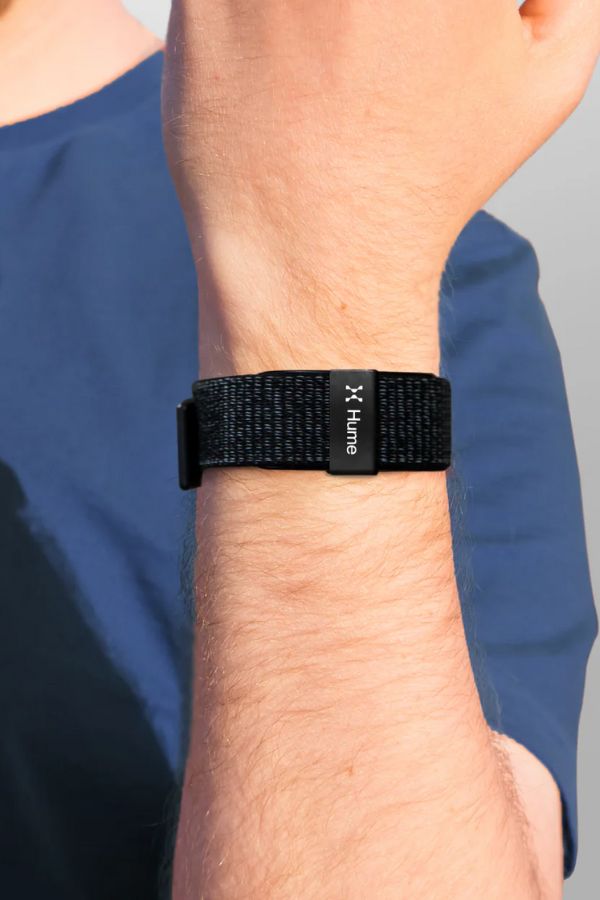
Hume is one of the lightest wearables on the market at around 8.6 grams, making it exceptionally comfortable for 24/7 wear. The 2.0 keeps that lightweight feel and adds an upgraded UltraLux strap that is positioned as a more premium material. Whoop is bulkier at around 26 grams but offers greater durability, band customization and even clothing integration for alternative wearing options. For overnight wear and all-day comfort, especially if you sleep on your side, the lighter Hume has the edge.
Hume supports Apple Health, Google Fit, Garmin and Fitbit, plus raw data exports. Whoop integrates mainly with Apple Health and Strava. Hume is the more open system, while Whoop encourages use within its own app ecosystem.
The most significant difference between the two is how you pay. The Hume Band 2.0 lists for $355.80, but you can bring that down significantly with stacked discounts. Visit through my partner link and the site automatically drops the price to $249.06. Then enter the code HEALNOURISHGROW at checkout for an additional $49.81 off, which brings the band to $199.25 before tax. With free shipping, that is $156.55 in total savings on a device with no required subscription. You own it and your insights forever. An optional Premium plan is available at $8.99/month for advanced AI coaching.
Whoop requires an active membership. Plans run from $199 per year at the entry level up to $239 for Whoop Peak and $359 for Whoop Life. Without the subscription, the device is unusable. Over several years, Whoop becomes a much higher ongoing investment, while the Hume Band is a one-time purchase at roughly the cost of a single year of Whoop.
If you have been researching Hume Band discount codes, here is the best deal I have found. You can stack two separate discounts to take the price from $355.80 down to $199.25 before tax.
Step 1: Visit the Hume Health site through my partner link. The site automatically applies a discount that drops the price from $355.80 to $249.06.
Step 2: At checkout, enter the code HEALNOURISHGROW in the discount code field. This takes an additional $49.81 off your order, bringing the total to $199.25 before tax.
Yes, the codes stack. I have tested this myself and confirmed it works at checkout on the Hume Band 2.0, for $156.55 in total savings. Free standard shipping (1 to 3 days) is also included, so there are no hidden costs. Compared to Whoop’s $199 to $359 per year subscription, the Hume Band at $199.25 with no recurring fees is a serious value. Hume also has a 45 day money back guarantee so you can try it risk free.
Disclosure: The link above is an affiliate link. If you purchase through it, I may earn a small commission at no extra cost to you. I only recommend products I personally use and believe in.
Both Whoop and Hume are excellent devices but serve different priorities:
For buyers, the decision ultimately comes down to daily performance versus long-term health span. Whoop remains the better tool for athletes optimizing training, while the Hume Band is the emerging leader for those who want longevity insights without subscriptions. With the 2.0 closing the battery gap and adding blood pressure tracking, the comparison is closer than ever. And if you are not sure a screen-free band is even the right form factor for you, check out my full guide to the best fitness watches and wearables for women, which covers rings, bands and watches based on your training goals.
It depends on what you are trying to optimize. If your primary focus is long-term health, longevity and metabolic insights without ongoing subscription costs, the Hume Band is the better choice. It tracks how your daily habits affect your biological age over time, which is something Whoop does not do.
If your priority is daily athletic performance with detailed strain scoring and a structured recovery system, Whoop has the edge there. For most health-conscious people who are not professional athletes, Hume offers more relevant insights at a lower total cost. For a broader look at all the options, see my guide to the best fitness watches for women.
The Hume Band 2.0 brings several upgrades over the original: battery life jumps from 5 to 7 days up to roughly 14 days, it adds blood pressure trend tracking, an upgraded UltraLux strap and improved signal processing. The sensor array and core metabolic health features remain the same. For most buyers the 2.0 is the version to get since it is the same retail price as the original. See my full Hume Band 2.0 review for the complete breakdown.
No. The Hume Band is a one-time purchase and all core health data, including sleep tracking, HRV, recovery metrics, blood pressure trends on the 2.0 and Metabolic Capacity scores, are available without a subscription.
There is an optional Premium plan for $8.99 per month that adds advanced AI coaching features, but it is not required to use the device or access your data. This is one of the biggest differences between Hume and Whoop, since Whoop locks all data behind a mandatory membership.
Yes, the Hume Band tracks steps and general activity, though step counting is one of the less reliable metrics on any wrist optical band. Hume is designed to go well beyond basic step counting, with its main focus on recovery, HRV trends, sleep quality and Metabolic Capacity, which show how your body is adapting to your habits over time. If step counting is your primary goal, most basic fitness trackers can do that. Where Hume stands out is in the deeper health data that steps alone do not capture.
Yes. Activity mode lets you start a session in the Hume app for live metric tracking during a workout, with activity types that run from running to weightlifting to yoga, and every session saves to My Day. The feature reached the Android version of the app in August 2026. In my strength training tests, sessions tracked in activity mode captured peak heart rate closer to my Whoop than passive tracking did. See my Hume Band 2.0 review for the full breakdown.
Yes. Whoop requires an active membership to access any of your data. The device itself is included with the subscription, but without paying, the band does not function at all.
Plans currently run from about $199 per year at the entry level, $239 per year for Whoop Peak and $359 per year for Whoop Life. Over two to three years, those subscription costs add up to significantly more than the Hume Band’s one-time purchase price. This is a major factor for anyone deciding between Hume vs Whoop.
Yes, both the Hume Band and Whoop are generally HSA and FSA eligible, since both are health monitoring devices. Whoop provides an itemized receipt for membership reimbursement, and the Hume Band qualifies as a one-time eligible purchase.
As always, eligibility can vary by plan, so check with your FSA or HSA administrator before purchasing. One advantage of the Hume Band is that because there is no subscription, you only submit a single claim rather than recurring ones.
The standard Whoop 5.0 does not track blood pressure. The Whoop MG (Medical Grade), available with the higher-tier Whoop Life plan at $359 per year, includes ECG and blood pressure monitoring features. The Hume Band 2.0 now offers blood pressure trend tracking on the standard device with no subscription, using optical sensors to monitor directional trends over time rather than clinical spot readings.
So both ecosystems now offer blood pressure insights, but Hume includes it on the base 2.0 device while Whoop reserves it for its most expensive tier. Neither is a replacement for a validated arm cuff.
Yes. Use the code HEALNOURISHGROW at checkout on the Hume Health website for an additional discount. If you visit through this partner link, an automatic discount is already applied, and the HEALNOURISHGROW code stacks on top of it. This brings the Hume Band from $355.80 down to $199.25 before tax, a total savings of $156.55.
Yes, the discounts stack. The partner link automatically reduces the price from $355.80 to $249.06. Then entering HEALNOURISHGROW at checkout takes an additional $49.81 off. I have personally verified this at checkout on the Hume Band 2.0. Free standard shipping is also included.
The best price I have found is by combining the automatic partner discount with the HEALNOURISHGROW checkout code. This combination brings the total to $199.25 before tax, which is $156.55 off the regular $355.80 list price. Unlike Whoop, there is no monthly subscription, so the Hume Band is a one-time purchase with no ongoing fees. Hume also offers a 45 day money back guarantee, so you can try it risk free before committing.
Tina Biles
I purchased both the hume band and scale. Rarely does my scale connect to my phone even though I have my apple health connected and it says it’s connected. I often get a error message on my scale inspite if doing all the problem recommendations numerous times.
I have sent multiple emails to the company and they haven’t answered one email.
Both the band and the scale are a huge waste of money and I regret buying them. I’m annoyed at the miss representation of the ads and the reviews.
Cheryl McColgan
I am really sorry to hear this! That definitely has not been my experience and the one issue I had with the app I contacted support there and they got me thought the problem, turned out it was totally user error in my case. At any rate, if you really can’t get an answer from them, contest the charge with your credit card company! If you can show you’ve contacted support several times with no response they will reverse the charge.