
Hume vs Whoop: Which Health Tracker Is Right for You? (Full Review)
When it comes to advanced health wearables, the Whoop Strap and the Hume Band take a unique approach. Both are screenless bands packed with sensors and analytics, yet they target different goals. Whoop is well-established among athletes for its focus on daily training load and recovery, while Hume is a newcomer aiming to “future-proof your health” by tracking longevity and metabolic fitness. In this comparison of hume vs whoop, l examine all major features side by side; from sleep and recovery to workouts, stress monitoring, battery life, app experience, comfort, integrations, pricing, and more.
I've worn the Hume Band for about two months now. When it comes to health wearables, I've tried a lot of them! Fitbit, Garmin, Samsung watch and I'm a long term user of the Oura ring. If you're still exploring which type of wearable is right for you, I've also put together a full guide to the best fitness watches for women that covers watches, bands, and rings side by side.

I've also been using the Hume Body Pod for over a year now to track my body composition and absolutely love it. You can check the full review here. The Hume body pod and hume band are integrated into the same app, which is super convenient. Between the two, you get some great health insights to make your goals more achievable.
If you already use a different wearable, you may wonder if you need a a Hume Band or Whoop. Each type and brand of wearable is more suited to recovery, general fitness, performance or sleep.
Hume Band Review
Where the Hume Band really shines is in the recovery and performance departments. While it's great for athletes, the Hume Band really caters to those of us who are interested in improving our overall health and longevity rather than just sports performance. It has unique features that show how certain behaviors affect your longevity over time and it can be very motivating to see you biological age going down as you implement new healthy habits. And, it still has all the features that give you insight into recovery and readiness for sports performance. If you decide you love the Hume Band like I do, follow the link and use code HEALNOURISHGROW at checkout to save over $150! The discounts stack, so you get the best possible price.
Disclaimer: Links may contain affiliate links, which means we may get paid a commission at no additional cost to you if you purchase through this page. Read our full disclosure here.
Feature Comparison Hume vs Whoop
| Feature | Hume Band | Whoop 5.0 |
|---|---|---|
| Sleep Tracking | Tracks sleep stages and quality, ties results to long-term metabolic health and resilience. | Detailed sleep stages and “Sleep Coach” recommending hours and bedtimes for optimal recovery. |
| Recovery & Readiness | Focuses on long-term resilience and Metabolic Capacity, showing whether habits are slowing or accelerating aging. | Provides a daily Recovery Score (0–100%) based on HRV, resting HR, and sleep, guiding daily training decisions. |
| Workouts & Fitness | Continuous HR, calories, and activity tracking. Strain is framed as impact on metabolic health over time. | Continuous HR, calories, VO₂ max, detailed Strain score for each workout and day. High accuracy, athlete-focused. |
| Stress Monitoring | Identifies early signs of stress, immune decline, or inflammation via HRV, resting HR, and temperature changes. | Tracks HRV and offers real-time stress scores (premium tiers). Breathwork guidance helps manage strain. |
| Battery Life | 5–7 days per charge. Fast recharge in ~30 minutes. | 12–14 days per charge. On-wrist charging with battery pack (higher-tier plans). |
| App Experience | Simple, modern app with weekly health scores and longevity insights. Optional AI coaching for $8.99/month. | Polished app with Sleep, Recovery, and Strain dashboards, plus community features. All data requires subscription. |
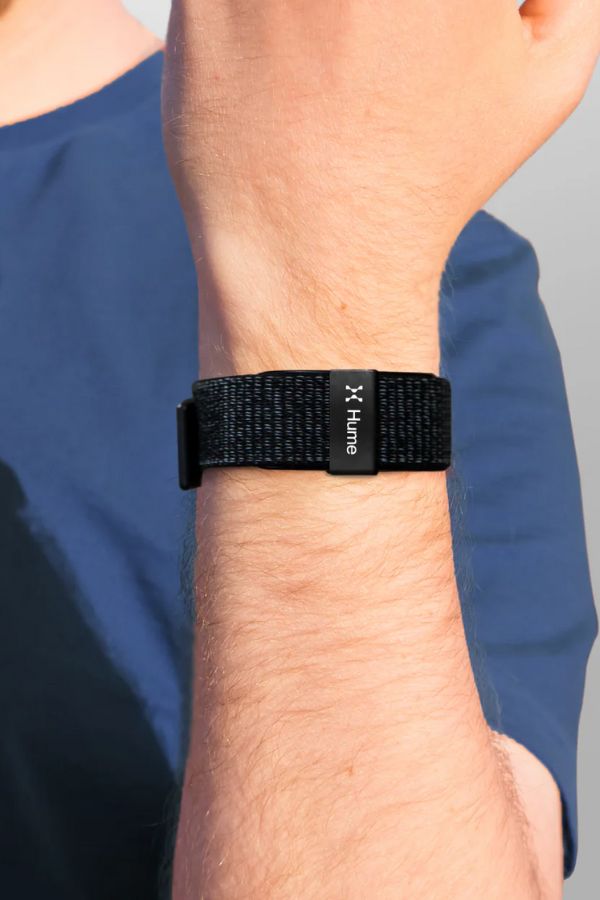
| Form Factor | Ultra-light (8.6g), minimalist, very comfortable for 24/7 wear. | Heavier (26.5g) but durable and customizable with multiple strap options. |
| Integrations | Syncs with Apple Health, Google Fit, Garmin, Fitbit. Raw data export supported. | Limited integrations. Works with Apple Health, Strava, some workout imports. No full raw data export. |
| Pricing | $355.80 retail, but as low as ~$199 with stacked discounts. No subscription required for core data. Optional Premium $8.99/mo for extra coaching. | Subscription required: $239/year (Whoop Peak). Higher tiers $359/year (Whoop Life) for advanced features. Device included with membership. |
Sleep Tracking Capabilities
Both Whoop and Hume excel at sleep tracking but present it differently. Hume ties nightly data to long-term metabolic resilience, while Whoop integrates sleep into daily performance readiness. Whoop's “Sleep Coach” is especially helpful for athletes needing to optimize recovery before big training sessions or competitions, while Hume helps users see how consistent rest impacts longevity and overall health.
Recovery and Readiness Metrics
Whoop offers a clear daily Recovery Score, ideal for athletes deciding whether to push or rest. Hume provides a Metabolic Capacity score, emphasizing long-term resilience. This makes Hume better suited for those concerned with preventing burnout or aging-related decline, while Whoop caters to daily sports training optimization.
Workout and Fitness Tracking
Whoop has the edge for performance athletes with its precise strain metric, heart rate accuracy, and VO₂ max estimates. Hume tracks workouts too, but frames them in terms of their contribution to health span and metabolic fitness. For casual exercisers or longevity-focused users, Hume provides enough context and insight without overwhelming detail.
Stress and Mental Health Monitoring
Hume monitors stress by detecting subtle biometric changes and warning users of possible overtraining, illness, or immune decline. Whoop offers real-time stress scores (in premium tiers) and breathwork tools, making it more useful for active stress management. Both help users identify the impact of lifestyle factors on recovery and mental well-being.
Battery Life and Charging
Whoop leads with 12–14 days of battery per charge, while Hume lasts 5–7 days. However, Hume recharges in just 30 minutes, compared to ~2 hours for Whoop. Whoop's on-wrist charging pack (included in higher plans) is convenient, but Hume's fast charge makes downtime minimal. After mostly wearing watches for these types of insights in the past, I found the charge on the Hume Band to be more than adequate. Fitness watches often need charging daily. At around a week, I really don't think battery life should be a consideration at all when deciding between Hume vs Whoop.
App Interface and Insights
The Whoop app is polished, data-rich, and community-driven — but requires an ongoing subscription. The Hume app is clean and simple, with weekly scores and clear longevity insights. Importantly, Hume does not lock core data behind a paywall, while Whoop does.
Form Factor and Comfort
At just 8.6 grams, Hume is one of the lightest wearables on the market, making it exceptionally comfortable for 24/7 wear. Whoop is bulkier at 26.5 grams but offers greater durability, band customization, and even clothing integration for alternative wearing options.
Compatibility and Integrations
Hume supports Apple Health, Google Fit, Garmin, and Fitbit, plus raw data exports. Whoop integrates mainly with Apple Health and Strava. Hume is the more open system, while Whoop encourages use within its own app ecosystem.
Pricing and Subscription
The most significant difference between the two is the Hume band price. The Hume Band retails for $355.80, but you can bring that down significantly with stacked discounts. Visit through my partner link and the site automatically drops the price to $249.06. Then enter the code HEALNOURISHGROW at checkout for an additional ~$50 off, bringing your total to roughly $199 before tax. That is over $150 in savings on a device with no required subscription. You own it and your insights forever. An optional Premium plan is available at $8.99/month for advanced AI coaching.
Whoop requires an active membership. The Whoop Peak plan is $239 per year, while Whoop Life is $359 per year. They also have a very basic level which is $199 a year, about the same cost as the Hume Band alone! Without the subscription, the device is unusable. Over several years, Whoop becomes a much higher ongoing investment.
How to Save on the Hume Band
If you have been researching Hume Band discount codes, here is the best deal I have found. You can stack two separate discounts to take the price from $355.80 down to around $199 before tax.
Step 1: Visit the Hume Health site through my partner link. The site automatically applies a discount that drops the price from $355.80 to $249.06.
Step 2: At checkout, enter the code HEALNOURISHGROW in the discount code field. This takes an additional ~$50 off your order, bringing the total to roughly $199 before tax.
Yes, the codes stack. I have tested this myself and confirmed it works at checkout. Free standard shipping (1 to 3 days) is also included, so there are no hidden costs. Compared to Whoop's $239 to $359 per year subscription, the Hume Band at ~$199 with no recurring fees is a serious value. Hume also has a 45 day money back guarantee so you can try it risk free!
Disclosure: The link above is an affiliate link. If you purchase through it, I may earn a small commission at no extra cost to you. I only recommend products I personally use and believe in.
Unique Differentiators
- Hume Band: Focus on longevity, metabolic capacity, no required subscription, extremely lightweight, integration with Hume Body Pod for body composition tracking.
- Whoop: Proven daily strain/recovery system, community and team challenges, polished app, wearable charging pack, and athlete validation in professional sports.
Hume vs Whoop: Which Should You Choose?
Both Whoop and Hume are excellent devices but serve different priorities:
- Choose Whoop if you are an athlete or performance-driven individual who values daily strain and recovery optimization, and don't mind the costly yearly subscription.
- Choose Hume Band if you are health-conscious, longevity-focused, prefer to avoid ongoing costs, and want a simpler, more comfortable tracker that ties habits to long-term resilience.
For buyers, the decision ultimately comes down to daily performance vs. long-term health span. Whoop remains a more known tracker having been in the market longer, while the Hume Band is the emerging leader for those who want actionable athletic performance and longevity insights without subscriptions. And if you're not sure a screen-free band is even the right form factor for you, check out my full guide to the best fitness watches and wearables for women, it covers rings, bands, and watches based on your training goals.
frequently asked questions
Is Hume Band better than Whoop?
It depends on what you are trying to optimize. If your primary focus is long-term health, longevity, and metabolic insights without ongoing subscription costs, the Hume Band is the better choice. It tracks how your daily habits affect your biological age over time, which is something Whoop does not do.
If your priority is daily athletic performance with detailed strain scoring and a structured recovery system, Whoop has the edge there. For most health-conscious people who are not professional athletes, Hume offers more relevant insights at a lower total cost. For a broader look at all the options, see my guide to the best fitness watches for women.
Does Hume Band require a subscription?
No. The Hume Band is a one-time purchase and all core health data, including sleep tracking, HRV, recovery metrics, and Metabolic Capacity scores, are available without a subscription.
There is an optional Premium plan for $8.99 per month that adds advanced AI coaching features, but it is not required to use the device or access your data. This is one of the biggest differences between Hume and Whoop, since Whoop locks all data behind a mandatory membership.
Does Hume Band track steps?
Yes, the Hume Band does track steps and general activity. However, Hume is designed to go well beyond basic step counting. Its main focus is on recovery, HRV trends, sleep quality, and Metabolic Capacity, which gives you a picture of how your body is adapting to your habits over time. If step counting is your primary goal, most basic fitness trackers can do that. Where Hume stands out is in showing you the deeper health data that steps alone do not capture.
Does Whoop have a subscription?
Yes. Whoop requires an active membership to access any of your data. The device itself is included with the subscription, but without paying, the band does not function at all.
Plans currently start at $199 per year for Whoop One, $239 per year for Whoop Peak, and $359 per year for Whoop Life. Over two to three years, those subscription costs add up to significantly more than the Hume Band's one-time purchase price. This is a major factor for anyone deciding between Hume vs Whoop.
Is Whoop FSA eligible?
Whoop memberships may be eligible for FSA (Flexible Spending Account) or HSA (Health Savings Account) reimbursement, but eligibility depends on your specific plan and provider. Whoop does provide an itemized receipt that some users have successfully submitted for reimbursement.
If this matters to you, check with your FSA or HSA administrator before purchasing. It is worth noting that the Hume Band's one-time purchase model may also qualify depending on your plan, and since there is no ongoing subscription, you would only need to submit a single claim rather than recurring ones.
Does Whoop track blood pressure?
The standard Whoop 5.0 does not track blood pressure. The Whoop MG (Medical Grade), which is available with the higher-tier Whoop Life plan at $359 per year, includes ECG and blood pressure monitoring features. The Hume Band does not currently track blood pressure either.
Both devices focus primarily on heart rate, HRV, sleep, and recovery metrics. If blood pressure monitoring is essential for you, the Whoop MG is one of the few wrist-worn wearables that offers it, though it comes at a significantly higher annual cost.
Is there a Hume Band discount code?
Yes. Use the code HEALNOURISHGROW at checkout on the Hume Health website for an additional ~20% off. If you visit through this partner link, an automatic discount is already applied, and the HEALNOURISHGROW code stacks on top of it. This brings the Hume Band from $355.80 down to around $199 before tax, a total savings of over $150.
Can you stack Hume Band discount codes?
Yes, the discounts stack. The partner link automatically reduces the price from $355.80 to $249.06. Then entering HEALNOURISHGROW at checkout takes an additional ~$50 off. I have personally verified this at checkout. Free standard shipping is also included.
What is the cheapest way to buy the Hume Band?
The best price I have found is by combining the automatic partner discount with the HEALNOURISHGROW checkout code. This combination brings the total to roughly $199 before tax, which is over $150 off the regular $355.80 retail price. Unlike Whoop, there is no monthly subscription, so the Hume Band is a one-time purchase with no ongoing fees. Hume also offers a 45 day money back guarantee, so you can try it risk free before committing.
Author


Tina Biles
I purchased both the hume band and scale. Rarely does my scale connect to my phone even though I have my apple health connected and it says it’s connected. I often get a error message on my scale inspite if doing all the problem recommendations numerous times.
I have sent multiple emails to the company and they haven’t answered one email.
Both the band and the scale are a huge waste of money and I regret buying them. I’m annoyed at the miss representation of the ads and the reviews.
Cheryl McColgan
I am really sorry to hear this! That definitely has not been my experience and the one issue I had with the app I contacted support there and they got me thought the problem, turned out it was totally user error in my case. At any rate, if you really can’t get an answer from them, contest the charge with your credit card company! If you can show you’ve contacted support several times with no response they will reverse the charge.